If you’ve ever peeled a sticky-backed film sheet off a roll and wrapped it around a device to protect the finish and make it look exactly the way you want it — that’s a skin wrap in a nutshell. A skin (also called a wrap or decal) is a thin sheet of adhesive vinyl cut to the precise dimensions of a specific phone model. Unlike a hard case, it adds almost no bulk; unlike bare glass and aluminum, it protects against the micro-scratches that accumulate in a pocket over weeks of real life. With Apple’s iPhone 17 line now in the wild — bringing a redesigned rear camera module, a new titanium-finish chassis on the Pro models, and subtly different body curves compared to the 16 series — the templates that worked perfectly on last year’s phone no longer fit this year’s. That means if you’re shopping for skins right now, fit accuracy is the first thing to evaluate, not the last. This guide walks you through exactly that, plus the material and finish decisions that determine how your wrap looks six months from now.
| EDITOR'S PICKCarbon Fiber Phone Skin Compati… | Mid-tierfor iPhone 17 Pro Max Skin Wrap… | Budget pickfor iPhone 17 PRO MAX Skin Wrap… | |
|---|---|---|---|
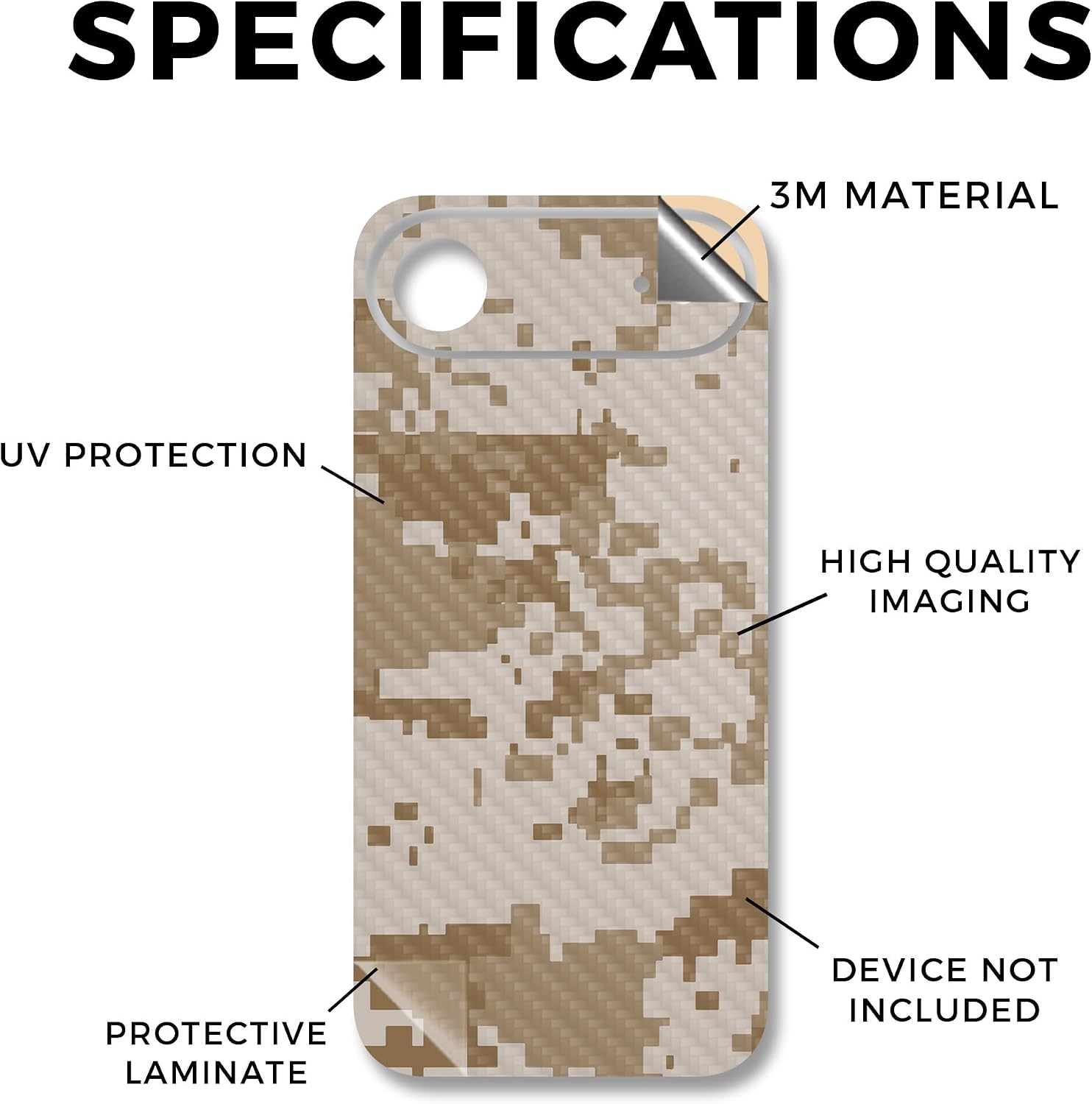
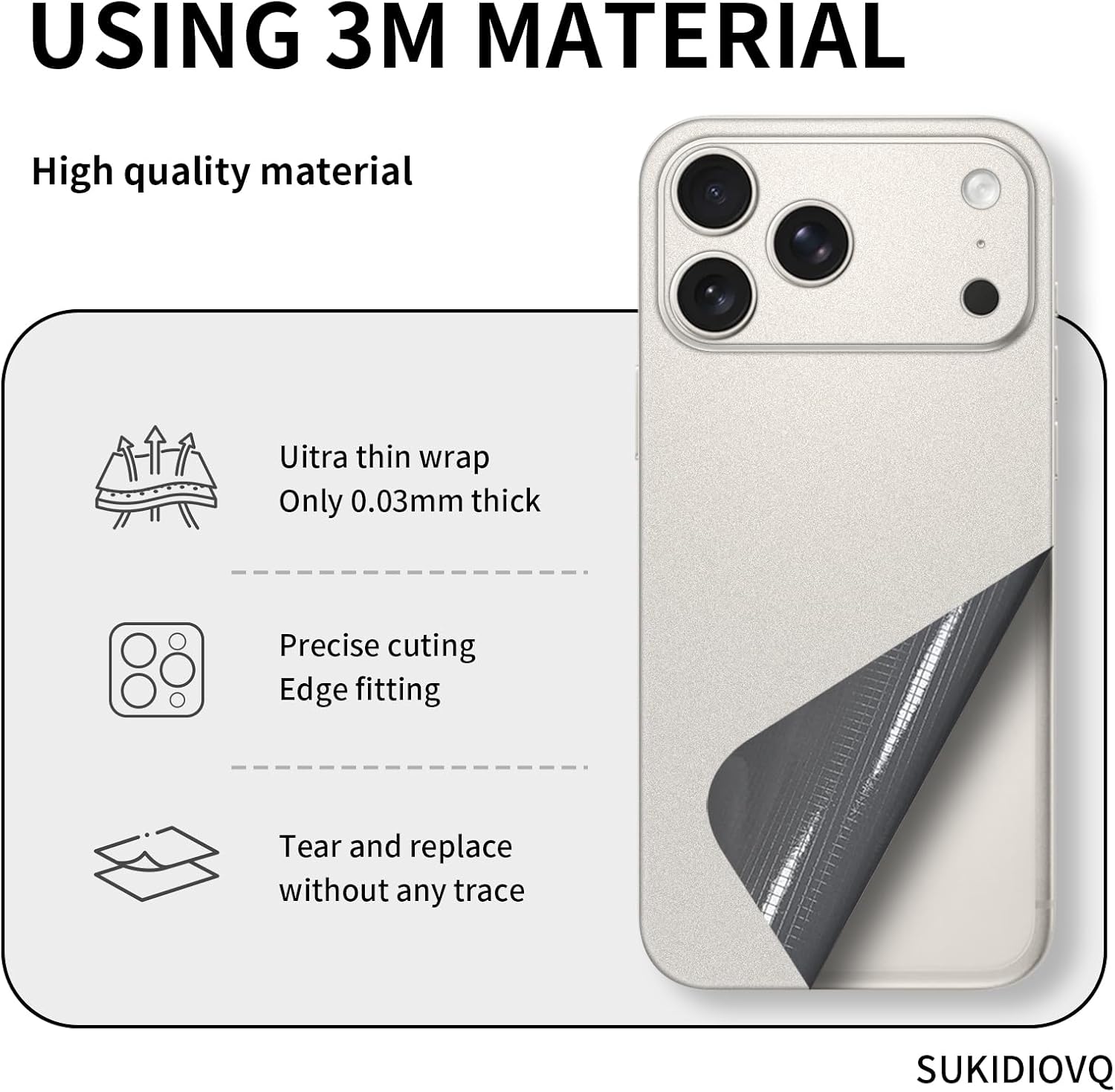
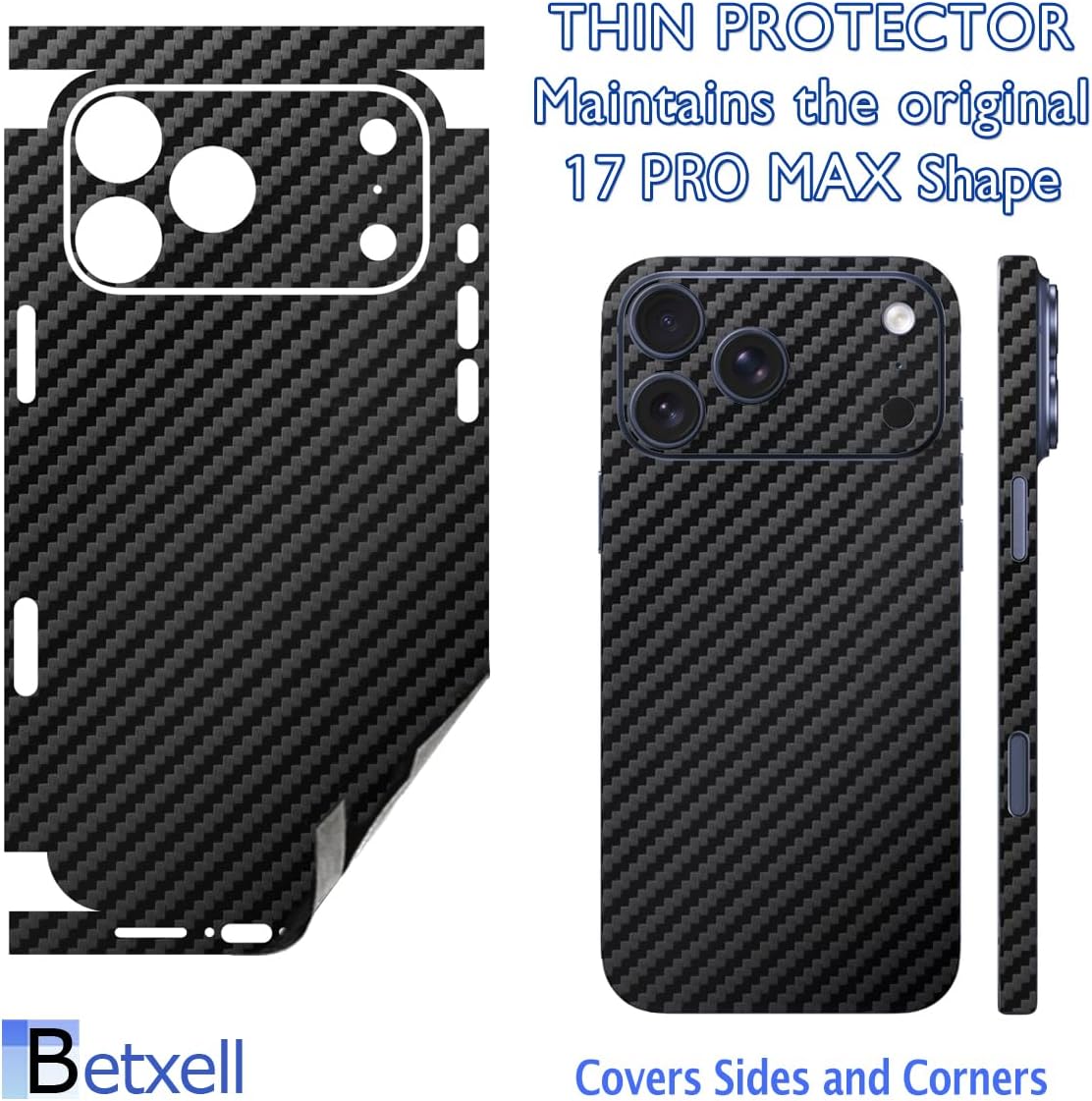
| Material | 3M Vinyl | 3M Material | 3M Film |
| Design | Desert Camo | Metallic Finish | Carbon Fiber |
| Coverage | — | Back Side | Sides and Back |
| Country | USA | — | — |
| Compatibility | iPhone Air | iPhone 17 Pro Max | iPhone 17 Pro Max |
| Price | $20.51 | $12.99 | $11.95 |
| See on Amazon → | See on Amazon → | See on Amazon → |
Why iPhone 17 Fit Accuracy Is a Fresh Problem (Even If You’ve Done This Before)
Anyone who skinned an iPhone 15 or 16 already knows the frustration of a template that’s 0.3 mm off: a tiny white edge showing at the camera ring, or a corner lift that starts within two weeks because the adhesive is bridging a curve it wasn’t designed for. The iPhone 17 raises the stakes on two fronts that reviewers at The Verge and CNET both noted in their coverage of the device.
The camera island geometry changed. The standard iPhone 17 introduces a horizontal camera bar that runs the full width of the rear panel — a significant departure from the circular island on the 16. The iPhone 17 Pro retains a triangular camera pod arrangement but with updated lens placement and a slightly deeper recess. Any brand selling “universal iPhone skins” or reusing 2024 templates for the 17 is selling you a misfit. Full stop.
The chassis radius tightened on the Pro models. Apple moved slightly closer to flat-edge geometry on the 17 Pro compared to the 16 Pro’s more rounded sides. That matters for wrap film because a sharper corner requires either a thinner film with higher conformability — the ability of a material to stretch and conform to a contoured surface without bubbling or lifting — or a precise edge-wrap tab cut into the template. Brands that laser-cut templates in-house after device launch can iterate their templates within days of getting physical units. Brands that outsource cutting to third-party die houses may be running on pre-release CAD data that doesn’t account for final production tolerances.
The practical decision rule: Before you buy any skin for the iPhone 17, check the brand’s “last updated” date on the template page. If it predates three weeks after the device’s general availability date, treat it as suspect until owner reports confirm fit. The pattern after a new iPhone launch is that second-wave buyers — those purchasing four to eight weeks post-launch — consistently report better fit accuracy than day-one buyers, simply because brands have had time to refine cuts from real-unit feedback.
3M-Backed vs. Generic Film: Where the Price Gap Actually Lives
This is the comparison that intermediate buyers most often get wrong, because “3M” gets used as a quality shorthand when it’s actually a manufacturing-process story. Here’s what the published spec sheets actually say.
Premium Cast Vinyl: 3M 1080 and Avery Dennison SW900
3M’s Wrap Film Series 1080, documented in the 3M Commercial Solutions Division product bulletin, is rated for conformability around curves with a minimum application radius of approximately 3 mm and carries a manufacturer-stated outdoor durability rating of up to seven years in direct exposure conditions — pro-rated by finish type, with gloss lasting longer than matte under UV. The adhesive system uses a micro-structured backing that allows repositioning during application and reduces trapped-air bubbles. It is a cast vinyl, meaning the film is poured and cured rather than extruded — a process that produces dimensional stability so the film resists shrinkage over time.
Avery Dennison’s Supreme Wrapping Film SW900, per the Avery Dennison Graphics Solutions SW900 technical data sheet, sits at a comparable tier. It is also a cast film with a similar conformability rating and repositionable adhesive, and it is the film of choice for a number of boutique skin studios that want to offer something they can stand behind for both automotive-wrap buyers and device wrap enthusiasts alike.
Wired’s coverage of phone protection accessories has consistently noted that the edge-retention difference between cast and calendered films becomes obvious in the first 60 to 90 days of carry — cast films hold their edges around cutouts and curved transitions noticeably longer.
Carbon
$20.51
In stock on Amazon
Check price on AmazonMid-Tier Calendered Film from Established Brands
Several established device-skin brands use calendered vinyl — extruded rather than cast — as the backing for their mid-range lines. Calendered films are thicker, less conformable, and shrink back toward their original dimensions over time, especially around curved edges and corners. The adhesive chemistry tends toward permanent-bond rather than repositionable, which sounds like a feature until you realize it means any application error is unrecoverable and removal risks finish damage. That said, for flat-panel sections such as back glass on the standard iPhone 17, a quality calendered film from an established brand performs close to cast vinyl in everyday use for 12-to-18-month ownership cycles. PCMag’s accessories coverage notes that mid-tier skins from reputable brands are a reasonable trade-off when budget is a constraint and the device sees moderate carry conditions.
for
$12.99
In stock on Amazon
Check price on AmazonBudget Generic Films: The Honest Assessment
Generic films backing skins priced in the eight-to-twelve-dollar range on mass marketplaces are almost always low-grade calendered vinyl. Conformability is limited, adhesive chemistry skews permanent, and shrinkage at edges and cutouts is a predictable outcome within the first 90 days. The practical ceiling for budget generic film is flat, low-stress panels. Camera cutout edges, corner wraps, and side rails on the iPhone 17 Pro’s tighter geometry will show edge lift and bubbling faster than premium cast alternatives. For buyers on a strict budget, using a generic skin on back glass only — skipping side and camera-surround wraps — gets the most useful mileage out of the lower price point.
for
$11.95
In stock on Amazon
Check price on AmazonFinish Durability in Real Daily-Carry Conditions
Once you’ve confirmed fit accuracy and settled on a film tier, finish selection is where most intermediate buyers underinvest their research time. The following breakdown covers the major finish categories and how each holds up under pocket carry — the harshest real-world condition for a phone skin.
Matte and Brushed Finishes
Matte black and matte color finishes are the most forgiving for fingerprints and micro-abrasion in a pocket. Owners consistently report that matte finishes show the least visual degradation over six to twelve months of daily carry. The tradeoff is that matte films are slightly more susceptible to edge lifting at cutout perimeters than gloss, because the surface texture creates marginally less adhesive contact area at thin edges. PCMag’s accessories coverage notes matte as the default recommendation for users who keep their phone without an additional hard case over the skin.
Brushed aluminum and brushed metal finishes are flat-texture films that simulate machined metal. They perform well for scratch resistance — the visual texture disguises micro-scratches that would be obvious on gloss — and they age gracefully. The tradeoff is that brushed metal finishes tend to be slightly stiffer than matte or gloss films of the same thickness, which can make application around the iPhone 17 Pro’s tighter corner radius more demanding. First-time applicators should use a heat gun or hair dryer on a low setting when conforming brushed films to curved edges.
for
$12.99
In stock on Amazon
Check price on AmazonTextured Specialty Finishes
Carbon fiber texture is a perennial favorite because it reads as premium in person and photographs well. The textured surface is, however, a dust and lint trap in pocket carry — owners consistently report needing to wipe it down more frequently than smooth finishes. More importantly, the 3D texture is embossed into the film surface, which means cuts around camera bumps and buttons need to be especially clean; a rough cut edge on a textured film looks noticeably worse than the same edge on a smooth film. If you’re buying carbon fiber for a new-geometry device like the iPhone 17, verified-fit templates matter more here than for any other finish.
Leather-texture films have grown significantly in the boutique skin market. The feel is genuinely distinctive — a matte, slightly grippy surface that reduces drop likelihood and reads as premium in hand. Durability reports from owners suggest leather-texture films hold up well to handling but show edge peel at cutout corners faster than plain matte, because the texture adds slight thickness variability at cut edges. Worth the premium if grip and tactile aesthetics are primary; matte black remains the more durable daily-carry choice on a pure longevity basis.
Carbon
$20.51
In stock on Amazon
Check price on AmazonHigh-Visual-Impact Finishes
Holographic and iridescent finishes deliver high visual impact but are the most maintenance-intensive in a pocket. The color-shift effect is produced by a multi-layer laminate that is vulnerable to both heat cycling and edge abrasion. The consistent recommendation across coverage at Wired and CNET is that holographic skins belong on devices that spend more time on a desk or in a display context than in a denim pocket. They are a strong choice for earbud cases, laptop lids, and gaming controllers — surfaces that see less abrasive pocket contact — but should be chosen with clear eyes for a primary carry phone.
for
$12.99
In stock on Amazon
Check price on AmazonMulti-Device Coordination: Building a Colorway Stack Around the iPhone 17
If you coordinate across phone, earbuds, laptop, and controller, the iPhone 17’s new horizontal camera bar creates an interesting aesthetic opportunity. The linear bar echoes the geometry of a MacBook’s hinge area, which means a brushed aluminum or carbon fiber finish that reads as “machined hardware” on the phone carries visually to a laptop wrap in the same finish more cohesively than the previous circular camera island did.
For coordinated buyers, the current constraint is that laptop and controller templates don’t need to be validated against new hardware the way the phone template does. You can confidently order laptop and earbud skins from your preferred brand now, then wait for second-wave template confirmation on the iPhone 17 body before completing the phone portion of the order. This two-step approach avoids the most common coordination frustration: committing to a colorway and then discovering the phone skin is miscut, which forces a return and a color-match delay.
The Decision Framework
Here is the plain “if X, then Y” breakdown based on everything above:
If you’re buying in the first 60 days of iPhone 17 availability: Prioritize brands with documented template-update policies and real-unit verification. Check explicitly for language indicating templates were revised from production units rather than pre-release CAD files. Hold off on boutique or small-studio orders until the seller confirms physical-unit validation.
If your priority is finish longevity over 12-plus months of pocket carry: Matte black on a 3M 1080-backed or equivalent cast-vinyl film is the defensible choice. It is not the most exciting option, but it is the one that looks the same in month ten as it did in month one.
If aesthetics and coordination are the primary purchase driver: Carbon fiber or brushed aluminum on a cast-vinyl film from a brand with verified iPhone 17 templates. Accept that carbon fiber requires more maintenance attention in pocket carry.
If you’re budget-constrained: A mid-grade calendered film on flat-panel sections — back glass only, no side wraps — performs close enough to premium film for 12-to-18-month ownership cycles. Avoid budget film for camera cutout edges or curved-transition zones; that is where the conformability gap shows up fastest.
If you’re building a coordinated multi-device set: Order the stable devices — laptop, earbuds, controller — now at your target finish, and gate the phone skin on confirmed second-wave template accuracy. The wait is typically three to six weeks post-launch, and it is worth it.
The iPhone 17’s design changes are meaningful enough that they reset the fit-accuracy baseline across most brands, even ones you have trusted on previous devices. Treat this new model like a first-time buy on the template question, even if you are a seasoned wrapper on everything else.